
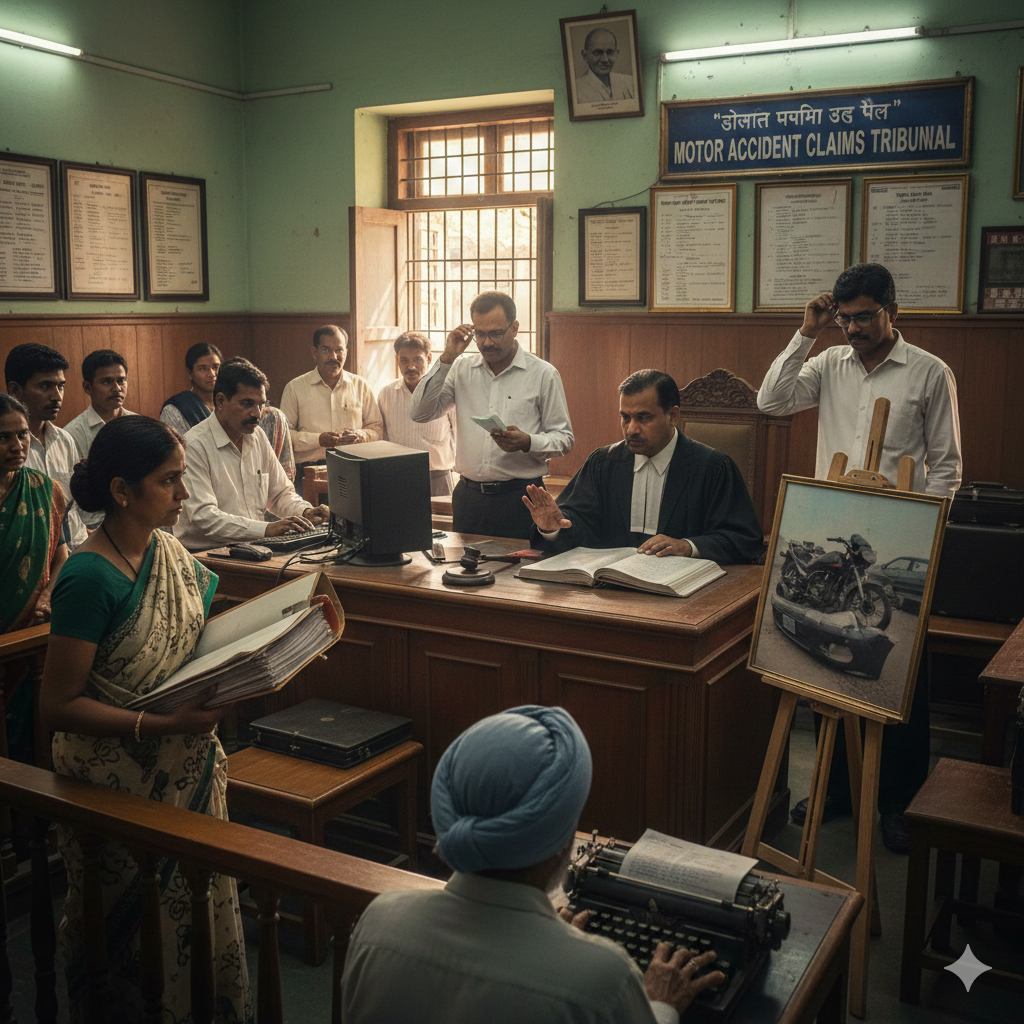
Motor accidents are unfortunately common across India, and the aftermath often leaves victims and families struggling with medical bills, loss of income, and emotional trauma. To address these challenges, the Motor Accident Claims Tribunal (MACT) was established under the Motor Vehicles Act, 1988. The Tribunal provides a specialized forum for victims and their families to seek compensation in a relatively speedy and less technical manner compared to civil courts.
Understanding MACT and Its Purpose
The Motor Accident Claims Tribunal is a quasi‑judicial body created to adjudicate claims arising out of motor vehicle accidents. Its primary objectives are:
- To provide speedy justice to accident victims.
- To simplify procedures compared to civil courts.
- To ensure fair compensation for injury, disability, or death.
- To balance the rights of victims with the obligations of drivers, vehicle owners, and insurers.
Unlike ordinary civil courts, MACT proceedings are less rigid in terms of evidence and procedure, making them more accessible to ordinary citizens.
Immediate Steps After an Accident
The foundation of a successful claim begins at the accident site. Victims or their families should:
- Seek medical help immediately. Health and safety come first.
- Inform the police. Filing an FIR is crucial for establishing liability.
- Document the accident. Photos, videos, witness details, and vehicle numbers are invaluable.
- Collect insurance details. Note the insurer’s name, policy number, and vehicle registration.
These early actions create the evidentiary backbone of the claim.
Gathering Essential Documents
Before filing a claim, certain documents must be collected and preserved:
- FIR and police report (DAR – Detailed Accident Report).**
- Medical records and bills.**
- Disability certificate (if applicable).**
- Proof of income** (salary slips, tax returns, employer certificate).
- Vehicle documents** (RC, insurance policy, driving licence).
- Death certificate and proof of relationship** (in fatal cases).
Organizing these documents systematically strengthens the claim petition.
Who Can File a Claim?
The right to file a claim lies with:
- Injured persons in the accident.
- Legal representatives of the deceased (spouse, children, parents).
- Property owners whose assets were damaged.
Claims are filed against the driver, owner, and insurer** of the offending vehicle. The insurer is usually a necessary party since compensation is primarily paid through insurance coverage.
Jurisdiction of MACT
A claim can be filed in the Tribunal:
- Where the accident occurred.
- Where the claimant resides.
- Where the insurer’s office is located.
This flexibility ensures accessibility for victims.
Filing the Claim Petition
The claim petition is the formal document submitted to the Tribunal. It should include:
- Details of the accident: Date, time, place, and manner.
- Parties involved: Driver, owner, insurer.
- Nature of injuries or death.
- Compensation sought: Itemized under medical expenses, loss of income, pain and suffering, etc.
- Supporting documents: FIR, medical bills, disability certificate, income proof.
The petition must be signed, verified, and filed with the requisite court fee.
Notice to Respondents
Once the petition is filed:
- The Tribunal issues notices to the driver, owner, and insurer.
- The insurer files a written statement, confirming policy details and raising defenses (e.g., invalid licence, breach of policy terms).
- The driver/owner may contest liability.
This stage sets the framework for the dispute.
Interim Compensation
Tribunals may grant interim relief to victims pending final adjudication. For example:
- Immediate medical expenses.
- Funeral costs in fatal cases.
- Interim compensation under Section 140 (no‑fault liability).
This ensures victims are not left destitute while the case proceeds.
Evidence Stage
Evidence is the heart of the case. It includes:
- Claimant’s affidavit: Narrating accident details, injuries, expenses, and impact on livelihood.
- Witness testimony: Eyewitnesses, doctors, employers, investigating officers.
- Medical evidence: Disability certificates, treatment records.
- Cross‑examination: Respondents test credibility and causation.
Tribunals adopt a flexible approach to evidence, focusing on fairness rather than strict technicalities.
10. Insurer’s Defenses
Insurance companies often raise defenses such as:
- Driver lacked a valid licence.
- Vehicle was not insured or policy expired.
- Breach of policy terms (e.g., unauthorized use).
- Contributory negligence by the victim.
The Tribunal weighs these defenses carefully, balancing victim rights with insurer obligations.
11. Assessment of Compensation
Compensation is calculated under various heads:
- Medical expenses.
- Loss of income (past and future).
- Pain and suffering.
- Loss of amenities.
- Attendant charges, diet, transport.
- Disability impact on earning capacity.
- Funeral expenses and loss of consortium (fatal cases).
Tribunals often use the multiplier method in fatal cases, considering age, income, and dependency.
12. Award and Interest
The Tribunal issues a reasoned award, specifying:
- Compensation amount.
- Interest rate (usually 6–9% per annum).
- Apportionment among dependents.
- Mode of disbursement (lump sum or fixed deposits).
Insurers are directed to deposit the award within a stipulated period.
13. Disbursement of Compensation
To protect victims, especially widows and minors:
- Part of the award is kept in fixed deposits.
- Withdrawals are regulated to prevent misuse.
- Beneficiaries receive periodic interest.
This ensures long‑term financial security.
14. Execution of Award
If insurers delay payment:
- Claimants can file execution petitions.
- Tribunal enforces recovery through attachment of property or bank accounts.
This mechanism ensures compliance with awards.
15. Appeals
Aggrieved parties may appeal to the High Court within 90 days. Grounds include:
- Errors in liability determination.
- Quantum miscalculation.
- Procedural irregularities.
Appeals require a statutory deposit by insurers to discourage frivolous challenges.
16. Practical Tips for Claimants
- File promptly; delays weaken credibility.
- Maintain consistency between FIR, medical records, and testimony.
- Preserve all bills and receipts.
- Obtain detailed disability assessments.
- Include future expenses (rehabilitation, assistive devices).
- Seek professional legal assistance.
17. Role of Digitalization
Recent reforms emphasize:
- DAR (Detailed Accident Report): Filed by police to streamline claims.
- Online filing and tracking.
- Standardized formats (e.g., Delhi’s MCTAP).
- Direct bank transfers of compensation.
Digitalization enhances transparency and speed.
18. Challenges in MACT Cases
Despite improvements, challenges remain:
- Delays due to backlog.
- Inadequate documentation by claimants.
- Resistance from insurers.
- Lack of awareness among victims.
Addressing these requires systemic reforms and better legal literacy.
19. Case Law Highlights
Indian courts have shaped MACT jurisprudence:
- Sarla Verma v. DTC (2009): Standardized multiplier method.
- Rajesh v. Rajbir Singh (2013): Enhanced compensation for loss of consortium.
- National Insurance Co. v. Pranay Sethi (2017): Guidelines on future prospects.
These precedents ensure uniformity and fairness.
20. Conclusion
MACT cases are a lifeline for accident victims and their families. By following the step‑by‑step process—documenting the accident, filing a claim, presenting evidence, and pursuing execution—claimants can secure rightful compensation. While challenges persist, reforms and judicial precedents continue to strengthen the system.